Most card games are designed for four or five players, then quietly tacked on a "2-player variant" that nobody really likes. The good two-player games are different by design: they take into account that there's no kingmaker, no group dynamic, no third party to swing things. Just you and one other person, repeating decisions until someone makes a mistake.
This is six card games we keep on the shelf for two. Couples, roommates, travel partners — the test we apply is simple: does it stay good after the tenth play? Each pick survives that test. They're ranked by accessibility, not by preference — pick the one that matches your evening.
Our 2-player picks
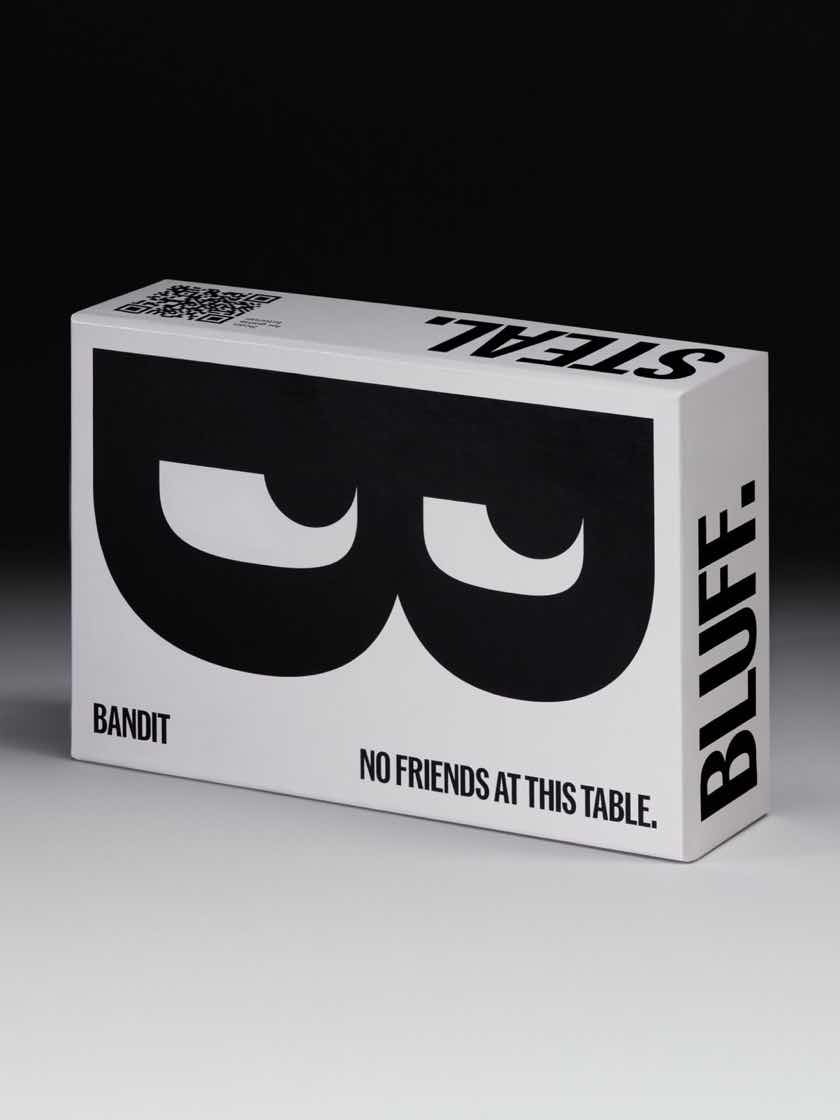
BANDIT
Bluff and memory for two players.
BANDIT can be played by two players. Each player initially knows two of their four cards; the remaining information comes from remembering revealed cards and watching the discard pile. Calling “Bandit” ends the round after the final-turn sequence, so timing the call matters. The same scoring, powers and immediate-discard rules apply as in games with more players.
Why it works for two:
At two players, turns alternate between the same two people, so each draw and discard updates the information to remember. The published playing time is about 30 minutes, with the same scoring, powers and immediate-discard rules.
Lost Cities
Reiner Knizia. Two players. One classic.
Lost Cities is the gold standard for 2-player card games and has been since 1999. You're competing archaeologists deciding which expeditions to fund — each expedition costs you points if you don't commit hard enough. The mechanic is brutally simple: cards in your hand, cards on the table, decisions about when to start a column and when to bail. Reiner Knizia at his most elegant.
Why it works for two:
Built ground-up for two. Every card you draw, every card the other player plays — it's all relevant information. The agonising decision of whether to start a new expedition or stick with what you have produces the kind of tension that no random number generator can fake.
7 Wonders Duel
Civilisation in 30 minutes. With knives.
7 Wonders Duel takes the tableau-building of 7 Wonders and rebuilds it for exactly two players. The cards form a pyramid on the table, half face-up, half face-down — you take turns picking, and what you don't take, your opponent will. Three paths to victory: military, science, civilian points. Whoever closes a path first ends the game. Sharp, replayable, and meatier than most card games on this list.
Why it works for two:
The pyramid mechanic is built around denial — you don't just optimise your tableau, you watch what your opponent needs and decide whether to take it. Three independent victory paths mean the game stays unpredictable across plays.
Hanamikoji
Seven geishas. Four actions. One tight game.
Hanamikoji is the kind of game that fits in your pocket but punches well above its size. You're courting seven geishas by offering them gifts, and you only have four actions across the whole round — each used exactly once. Some of the actions force your opponent to choose, which is where the bluff lives. Ten-minute rounds, but you'll play three before going to bed.
Why it works for two:
Tiny rule set, deep decisions. Each action you spend is one less you have, and the "I split, you choose" mechanic creates real tension. Ideal for travel because it's minuscule, but it doesn't feel small to play.
Jaipur
Two traders. One market. Camels everywhere.
Jaipur turns trading at a market into a tight 2-player race. You and your opponent are both traders trying to win the favour of the Maharaja by collecting goods, selling them at the right moment, and using camels as a buffer. Three rounds, maybe twenty minutes total. The market refreshes constantly so the decisions feel new every turn.
Why it works for two:
Designed exclusively for two — every mechanic assumes there's exactly one opponent. The "should I sell now or hold for a bigger combo" tension is the whole game, and it scales beautifully across re-plays. Bonus: it teaches without ever feeling like a tutorial.
Skyjo
Numbers, nerves, and one number too many.
Skyjo isn't built specifically for two but it works extraordinarily well there. Each player has twelve cards face-down, and you're trying to keep your total as low as possible by swapping bad cards for the discard pile. The 2-player version is faster than four — fewer cards to track, more decisions per turn. Excellent gateway game and surprisingly tense even after twenty plays.
Why it works for two:
Most "scales-down" games feel anaemic at two. Skyjo doesn't because the discard pile becomes a shared instrument — what your opponent throws away and what they keep is half the game. Five minutes to teach, your second game starts before the first is over.
Ready for the table
Choose your BANDIT quantity
Compare six card games for two players by rules, playing time, information, and interaction.
One game costs €22.00, two cost €39.00, and the 3-game pack costs €44.00 (2+1 compared with the €22.00 unit price).
Which 2-player card game for which evening?
If you want the shortest learning curve for someone new to modern card games: Skyjo. If you want a tense bluff duel where reading your opponent matters: BANDIT. For elegant strategic depth without overhead: Hanamikoji or Lost Cities. If you want a longer, meatier session with civilisation feel: 7 Wonders Duel. And for a punchy trading game that travels well: Jaipur.
Travel tip: BANDIT, Hanamikoji and Skyjo all fit in a coat pocket. Lost Cities and Jaipur need a small bag. 7 Wonders Duel needs a real table.
You can try BANDIT online against bots. The tutorial shows setup, turn sequence, card powers and immediate-discard timing.